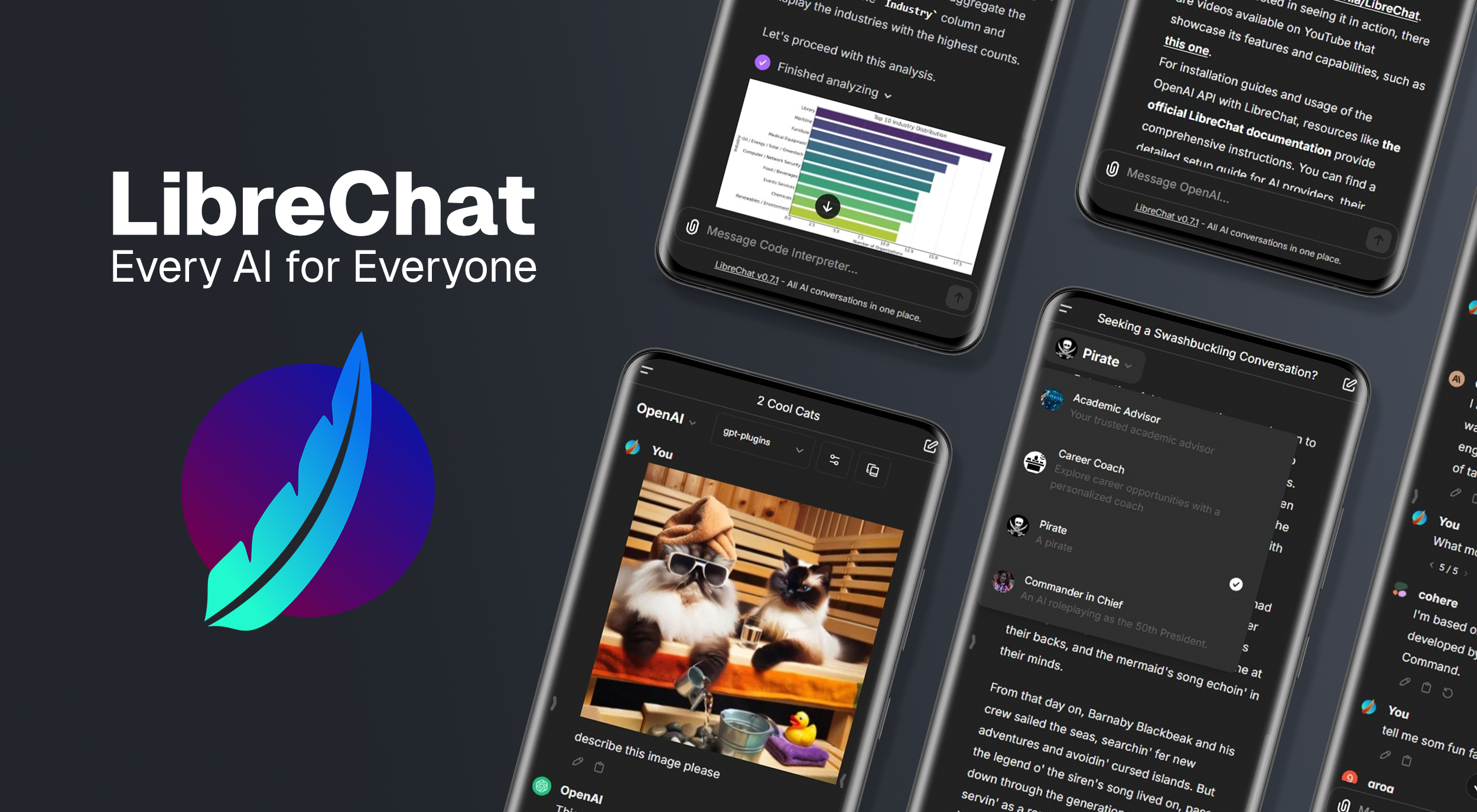
What it does
Core capabilities at a glance
- Multi-model support (OpenAI, Anthropic, Google, Ollama, etc.)
- Multi-user with role-based access control
- Presets and prompt templates
- File upload with OCR and RAG
- Plugins and tools (code interpreter, DALL-E)
- Preserve context across sessions
Deep dive
The full breakdown - performance, comparisons, and setup
LibreChat
LibreChat started as a ChatGPT clone and evolved into one of the most complete self-hosted chat platforms. It supports multiple models, user accounts, file uploads, plugins, and a preset system that power users love.
What it is
LibreChat is a full-stack chat application (Node.js backend + React frontend) that provides a ChatGPT-like experience with significantly more flexibility. It supports every major LLM provider, lets you create custom presets, upload files for analysis, and manage multiple users with role-based permissions.
Why this matters
LibreChat solves the "I want ChatGPT but self-hosted" problem with production-grade features:
- Multi-user with RBAC: admin, user, and custom roles with granular permissions
- Preset system: save model choice, system prompt, and parameters as reusable presets
- File upload: OCR for images, text extraction from PDFs, code files
- Plugin architecture: extend with custom tools and integrations
How it stacks up
| LibreChat | Open WebUI | LobeChat | NextChat | |
|---|---|---|---|---|
| Multi-user | ✓ (RBAC) | ✓ (RBAC) | Basic | ✗ |
| Presets | ✓✓ | Basic | Basic | Basic |
| Plugins | ✓ | ✗ | ✓ (100+) | ✓ (basic) |
| File upload | ✓ (OCR) | ✓ | ✓ | ✗ |
| Setup complexity | Medium | Low | Medium | Low |
| Best for | Teams, power users | Teams, simplicity | Plugins, customization | Lightweight |
What runs on it
- Ollama - connect as a local provider
- AnythingLLM - for dedicated RAG workflows alongside LibreChat
- Open WebUI - simpler team alternative
Get started
# Clone and run with docker-compose
git clone https://github.com/danny-avila/LibreChat.git
cd LibreChat
cp .env.example .env
# Edit .env with your API keys
docker-compose up -d
When to use something else
- Simpler setup: Open WebUI is easier to deploy
- Plugin ecosystem: LobeChat has a larger plugin marketplace
- Lightweight: NextChat if you don't need multi-user
From the community
What users are saying
“The part I suspect most are here for: - LibreChat remains 100% open-source under its existing MIT license - Community-first development continues with the same transparency and openness of course, no binding commitment to any of that in the long term.”
“It looks like it can connect to local models via LiteLLM proxy. Related issue: https://github.com/danny-avila/LibreChat/issues/1131 LiteLLM: https://github.com/BerriAI/litellm Guide: https://github.com/danny-avila/LibreChat/blob/main/docs/inst...”
“We aren't a charity. But, we are also a database provider. Ryadh mentions some examples below where we have joined forces, incorporated code into ClickHouse Cloud (our commercial offering), and OSS has grown. Time will tell (I can't predict future)...but I'm excited about the future of OSS LibreChat.”
Frequently asked
Quick answers to common questions
What is LibreChat?
LibreChat is a chat-ui tool for local AI workloads. Enhanced ChatGPT clone with multi-model, multi-user, and multi-server support for teams.
Is LibreChat free and open source?
Yes, LibreChat has 45,941 GitHub stars and is licensed under MIT. You can self-host it for free on web, docker.
What platforms does LibreChat support?
LibreChat runs on web, docker.
What hardware do I need for LibreChat?
The hardware requirements depend on which models you run. Check our hardware directory for compatible GPUs and systems. LibreChat has 45,941 GitHub stars and an active community.
Does LibreChat support GPU acceleration?
LibreChat's GPU support depends on your specific setup. Check the documentation for details. For the best performance, pair it with an NVIDIA RTX 4090 or 5090.
What are the best alternatives to LibreChat?
Popular alternatives include other chat-ui tools in our directory. Browse our full collection at /tool for comparisons, community reviews, and benchmark data to find the right fit for your workflow.
How much does LibreChat cost?
LibreChat is free-open-source. It is completely free and open source to self-host.
Pairs well with
Complementary tools, models, and hardware